The Golden Valley Light railway
A 2ft (610mm) Narrow Gauge Railway in Derbyshire
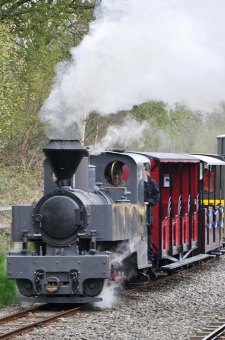
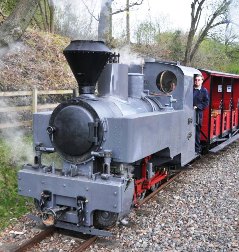
Kerr Stuart 3014 Jofree
History
This loco was ordered by the French Commission for their artillery railways, and was delivered new to Nantes, France. The French military achieved considerable standardisation in the locomotives which they used to support their operations during World War One.
This loco, although built in Stoke-on-Trent by Kerr Stuart, is very similar to locos built by the French company Decauville; it seems highly likely that the French issued Kerr Stuart with the design drawings. Kerr Stuart built 70 locos of this type. After the war, it was sold from Verdun to a dealer, Brunner and Marchand of Borray, Seine and Oise. In October 1930, it was sold on to Societe Anonyme des Carrieres de la Valee Heureuse et du Haut Banc, Marquise Rinxent in the Pas de Calais area of northern France. This was a stone quarry, and had at least four other similar locos. By August 1956, the locos on this site were derelict. It was repatriated to the UK on-board the ferry "Free Enterprise VII" on 11/10/74.
It was moved to the abortive museum project at Pen-yr-Orsedd quarry, North Wales, and then on to the Gloddfa Ganol slate quarry museum complex, near Blaneau Ffestiniog. Here, it was mounted on a plinth by the museum operator's house, and became a familiar site to passing motorists as they struggled up the legendary Crimea Pass road out of Blaneau to the north. Following closure of the Gloddfa Ganol museum, the loco joined the MRT collection on 10/3/98. The locomotive has been restored at a number of sites, most recently at Dove Holes near Buxton. It was moved to the Moseley Railway Trust's site at Apedale in August 2011, and starred in the "Made in Staffordshire" gala of that year, since when it has regularly hauled trains on the Apedale Valley Light Railway.
| Built - | 1916 |
.
at
The Apedale Valley Light Railway
at
The Apedale Valley Light Railway